You already know that running keeps your heart healthy and your weight in check. But a brand-new study published in Scientific Reports (June 2026) just revealed something remarkable: if you’re an older runner, you may be sleeping better than people half your age who don’t run. Here’s what the science says — and what you can do about it tonight.
What the Study Found
Researchers at Comenius University in Bratislava studied 39 men split into four groups: young runners (20–30), young non-runners, older runners (65–78), and older non-runners. They tracked sleep with wrist actigraphs, measured melatonin levels in urine, and monitored 24-hour activity rhythms for a week.
The headline finding: older runners had significantly better sleep than older non-runners — less fragmented sleep, longer stretches of uninterrupted sleep, and higher sleep efficiency. Meanwhile, older non-runners showed the classic aging sleep pattern: waking frequently, shorter sleep bouts, poor efficiency.
The Numbers That Should Excite You
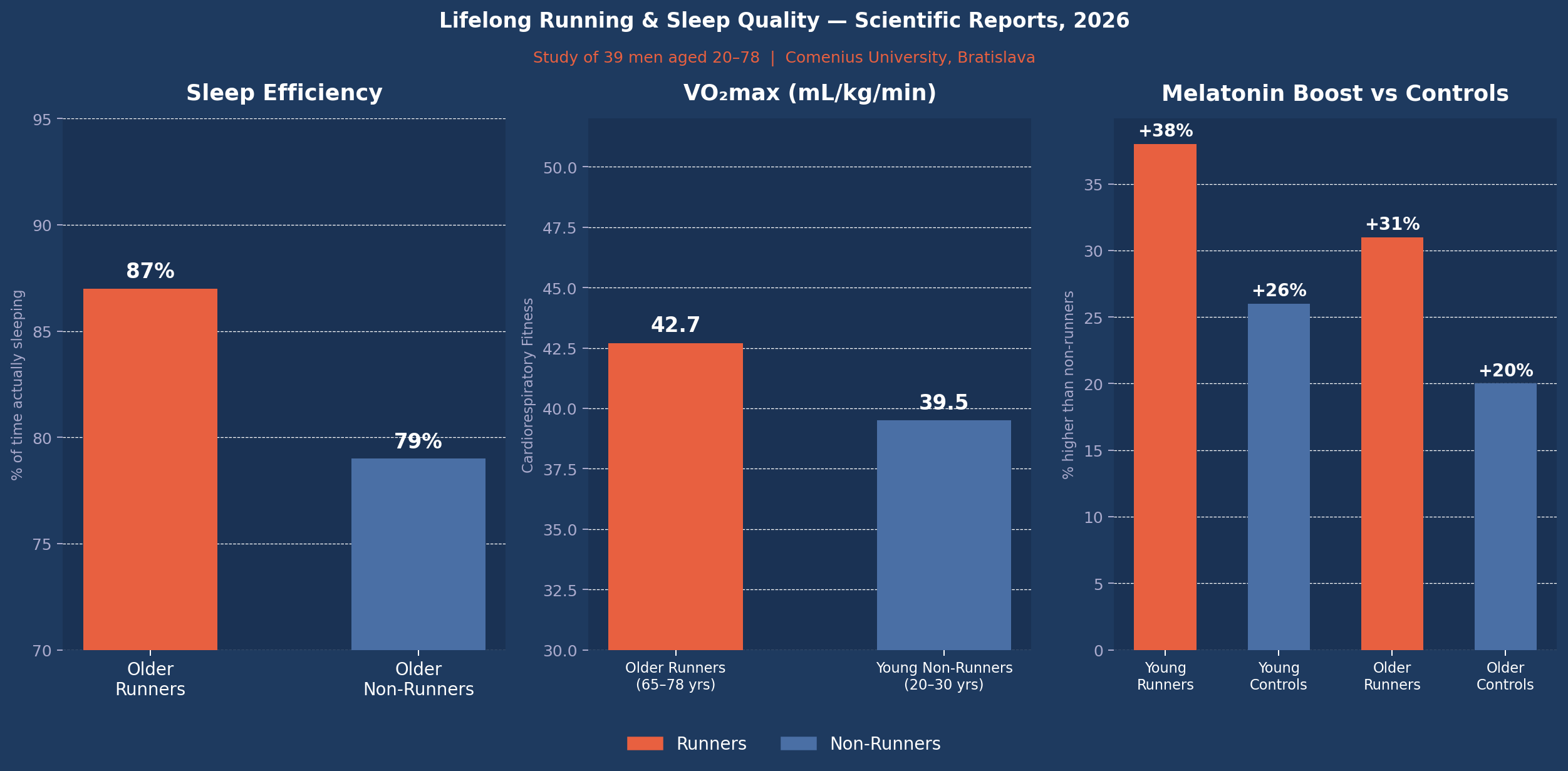
- Sleep efficiency: Older runners slept roughly 87% of their time in bed. Older non-runners? Around 79%. That’s the difference between waking up refreshed and dragging through the morning.
- VO₂max shocker: Older runners aged 65–78 had a VO₂max of 42.7 mL/kg/min — higher than untrained young men in their 20s (39.5). Running doesn’t just slow aging. It reverses it.
- Melatonin: Runners in both age groups produced significantly more melatonin than non-runners. More melatonin = deeper sleep, stronger immune function, and better circadian rhythm regulation.
- Rest-activity amplitude: Runners had a sharper contrast between active daytime and restful nighttime — essentially a more “youthful” biological clock.
Why This Happens: The Circadian Clock Connection
As we age, our circadian clock — the internal 24-hour timer governing sleep, hormones, and metabolism — becomes less robust. The good news: running appears to re-synchronize it. Running outdoors is especially powerful because it combines physical exertion with daylight exposure, giving your circadian clock two signals at once to stay calibrated.
Think of your circadian rhythm like a tuning fork. Age makes it go flat. Running keeps it ringing clearly.
What You Can Do Right Now
- Run in the morning or early afternoon. Morning/early afternoon exercise advances your circadian phase — meaning you’ll feel sleepy earlier and sleep more deeply. Evening runs can delay it.
- Run outdoors when possible. Light exposure amplifies the circadian benefits beyond what a treadmill provides.
- Be consistent. These were lifelong runners — the older group had been running regularly for at least 15 years. The sleep benefits compound over time. Every year you keep running is an investment in future sleep quality.
- Don’t worry if you started late. The mechanisms that improve melatonin production and circadian stability respond to current training, not just lifetime volume. Start now.
The Bottom Line
Poor sleep is one of the most consistent predictors of accelerated aging — it impairs memory, raises cortisol, suppresses immunity, and increases cardiovascular risk. This study adds to a growing mountain of evidence that running is one of the most powerful tools available to combat age-related sleep decline.
If you’re a runner over 50 and you’ve ever wondered whether all those early morning miles are worth it — your sleep data says yes.