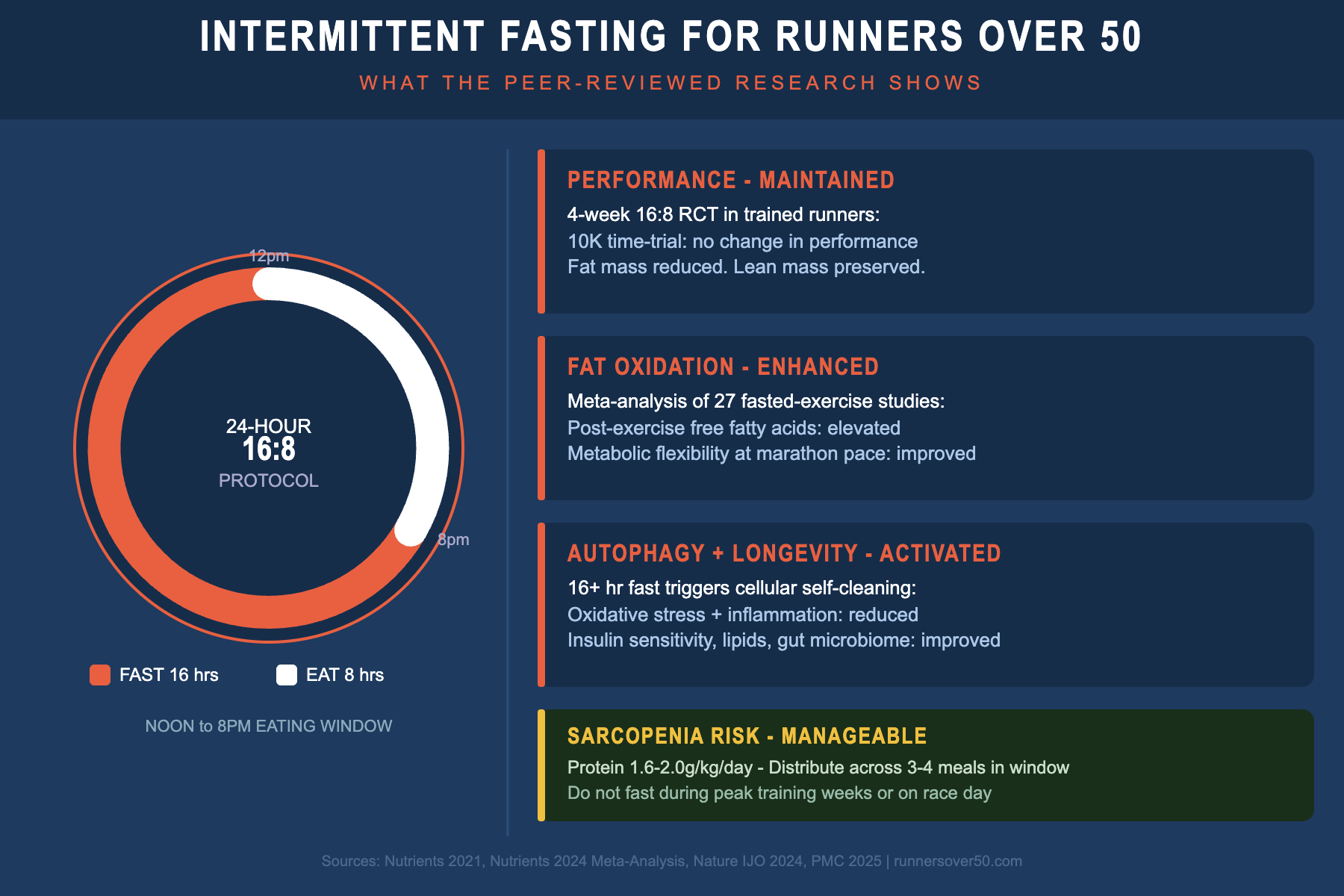
Every few months, intermittent fasting (IF) cycles back into the conversation — and for good reason. For runners over 50, the question isn’t just “does it work?” It’s more nuanced: does it work for us, specifically? We’re not 28-year-olds optimizing body composition for aesthetics. We’re athletes managing muscle preservation, recovery, inflammation, and longevity — all at once.
Here’s what the peer-reviewed research actually says.
What “Intermittent Fasting” Means in the Research
Most studies use one of two protocols:
- 16:8 time-restricted eating (TRE) — eat within an 8-hour window, fast 16 hours. The most studied in runners.
- 5:2 fasting — eat normally five days, restrict to ~500 calories two non-consecutive days. Less studied in athletes.
For runners, 16:8 is the practical one. Typically that means skipping breakfast, eating noon to 8pm, and doing morning runs in a fasted state.
The Core Finding: Body Composition Improves, Performance Doesn’t Suffer
The most rigorous runner-specific study to date — a 2021 randomized trial published in Nutrients — put trained male endurance runners on 4 weeks of 16:8 TRE. Fat mass dropped significantly. 10K time-trial performance was unchanged. Lean mass was preserved.
A companion study confirmed that the same 16:8 protocol in long-distance runners did not negatively affect cardiometabolic risk factors — cholesterol, blood pressure, and blood glucose all remained stable or improved.
A 2024 systematic review and meta-analysis in Nutrients — covering randomized controlled trials through April 2024 — concluded that IF combined with exercise improved body composition and did not impair VO2max or endurance performance.
A 2024 meta-analysis in Nature’s International Journal of Obesity confirmed the same pattern: time-restricted eating with exercise produces fat loss while preserving lean mass — the best possible outcome for masters runners.
Bottom line: For moderate-intensity runs, fasting doesn’t hurt your performance — and the fat loss it produces improves your power-to-weight ratio, which translates to better efficiency over distance.
Why Fasted Running Changes Your Fuel System
When you run in a fasted state, glycogen stores are partially depleted. Your body shifts toward fat oxidation earlier and more efficiently. A meta-analysis of 27 studies found that fasted exercise increased post-exercise circulating free fatty acids — meaning your body gets better at mobilizing and burning fat as fuel.
This matters for distance runners. The ability to oxidize fat at marathon pace is one of the strongest predictors of performance and durability at 50+. You’re training a metabolic pathway, not just your legs.
The Longevity Angle: Autophagy
This is where IF gets genuinely exciting for runners over 50.
Fasting windows of 16+ hours activate autophagy — your cells’ self-cleaning mechanism. Damaged proteins and organelles are broken down and recycled. A 2024 study confirmed that IF regulates the aging process through autophagy, reducing oxidative stress and inflammation.
A 2025 comprehensive review documented that IF improves insulin sensitivity, lipid profiles, cardioprotective effects, neurocognitive function, and gut microbiome diversity — all of which degrade with age, and all of which matter to a runner’s long-term health.
For masters runners who already have the aerobic engine, IF may be one of the few remaining levers to improve the biological environment that engine runs in.
The Real Risk: Protein Timing and Sarcopenia
Here’s where it gets important for runners over 50 specifically.
After 50, muscle protein synthesis is less efficient. We require more protein per day than younger runners to maintain lean mass, and we need it distributed throughout the day — not front-loaded into a compressed eating window. Research is clear that spreading protein intake across meals is superior to concentrating it in one or two large servings.
A PMC review on muscle-centric perspectives on IF flagged this directly: for older athletes, compressing all eating into 8 hours may reduce total protein intake and reduce the anabolic signal that keeps muscle intact.
The workaround is straightforward: Hit your protein targets (1.6–2.0g/kg body weight daily) and distribute across at least 3–4 protein servings within your eating window. If you’re doing 16:8 noon to 8pm, that means meals at noon, 3pm, 6pm, and 8pm. Don’t just eat less — eat the same protein, compressed.
Practical Protocol for Runners Over 50
Based on the research, here’s what a sensible approach looks like:
Best fit for IF: Base training and easy weeks — not peak training blocks or taper weeks before a race.
Window: 16:8. Noon to 8pm. Morning run fasted.
Easy runs (under 70% max HR): Fine fasted. This is where fat oxidation adaptation happens.
Long runs or tempo work: Consider a small carbohydrate snack before runs over 90 minutes. Performance suffers in prolonged high-intensity fasted states.
Protein: 1.6–2.0g/kg/day, distributed across 3–4 meals within your window.
Don’t do: Race day fasted. Don’t fast during peak training weeks. Don’t treat IF as a substitute for overall caloric adequacy.
The Bottom Line
For runners over 50, the science on intermittent fasting is more encouraging than the headlines suggest — with one important caveat. The body composition and metabolic benefits are real and replicable. The performance risk is minimal if you train smart. The longevity signal through autophagy is compelling.
The risk — sarcopenia — is manageable with deliberate protein strategy.
This isn’t a fad. It’s a metabolic tool. Used correctly, it fits the way runners over 50 already train.
Dr. Lyle Dennis is a neurologist and founder of Runners Over 50. He has completed 20 consecutive NYC Marathons.