A clinical look at what actually changes after 50 — and how to train around it.
What’s declining, what’s compensating, and what’s still entirely within my control. The honest clinical answer is that marathon training after 50 is not “the same plan, slower.” It’s a different physiological problem, and the research on masters endurance athletes is now specific enough to tell us where to spend our limited recovery capacity.
What Actually Declines — And What Doesn’t
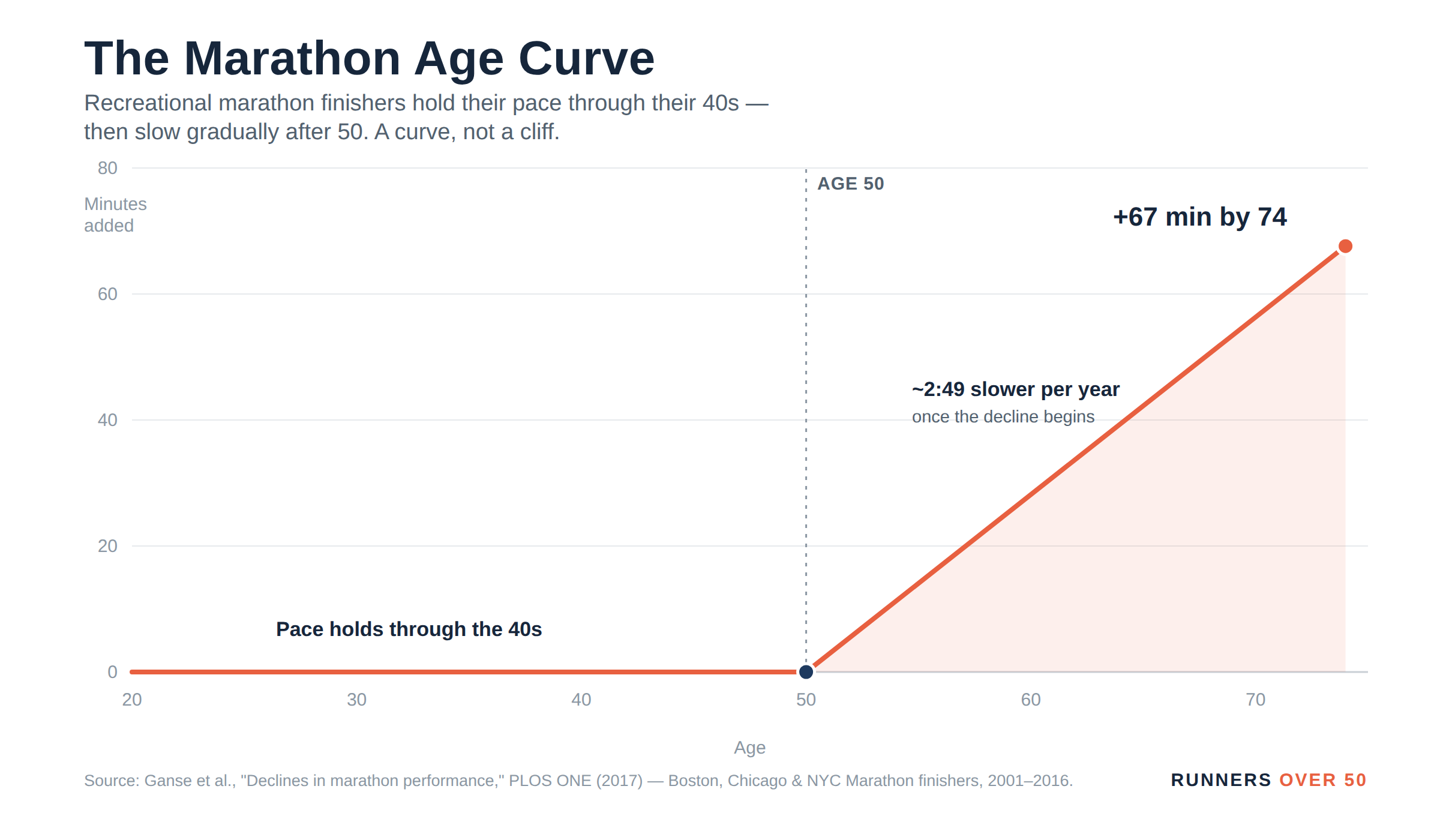
The foundational work here is Tanaka and Seals’ 2008 review in The Journal of Physiology, which remains the reference point for masters endurance physiology. Their key finding: peak endurance performance holds steady until roughly age 35, degrades modestly through the 50s, and then declines more steeply from 60 onward — a curve, not a cliff. The primary driver is a progressive fall in VO2max, which itself traces mostly to cardiovascular changes: a lower maximal heart rate, and in many athletes, reduced maximal stroke volume and a narrower arterio-venous oxygen difference. Lactate threshold contributes as a secondary factor.
Here’s the finding that should reassure every masters marathoner: running economy does not decline with age in athletes who keep training. Highly trained runners in their late 50s use oxygen just as efficiently at a given pace as their younger counterparts. Your stride doesn’t get worse with age — your engine’s peak output does. That distinction matters, because it means marathon training after 50 isn’t about relearning how to run. It’s about managing a smaller aerobic ceiling and a longer recovery curve.
There’s also a genuine physiological advantage worth knowing about: trained masters athletes shift a larger share of their energy production to fat oxidation at a given intensity than younger runners do — some data puts masters athletes’ peak fat-oxidation zone around 59–64% of VO2max, versus roughly 47–52% in untrained younger adults. For a marathon, where glycogen depletion is the enemy at mile 20, that’s a meaningful fueling edge, not just a consolation prize.
The Two Tissues That Change the Rules
Two structural changes matter more for training design than VO2max does.
Tendon. Research on aging tendon (published in the Journal of Applied Physiology) shows that collagen turnover slows and tendons become stiffer and less resilient with age, which raises the injury threshold for high-volume, high-intensity running — Achilles and patellar tendinopathy are disproportionately common in masters runners. The tissue adapts more slowly to load than muscle does, so mileage increases that would be safe at 30 need a longer runway at 55.
Muscle. Age-related loss of muscle mass and strength (sarcopenia) disproportionately affects fast-twitch, type II fibers — the fibers responsible for the neuromuscular power that keeps your form intact in the marathon’s final miles. This is precisely why late-race form collapse, and the injuries that follow from it, hit masters runners harder. The evidence here is unusually actionable: resistance training measurably slows and partially reverses this type II fiber atrophy, and a meta-analysis in the Journal of Strength and Conditioning Research found that strength training improves running economy in already well-trained distance runners. Strength work isn’t cross-training for a masters marathoner. It’s primary training.
How the Plan Should Actually Differ
Putting the physiology together, three adjustments separate an intelligent masters marathon plan from a young runner’s plan scaled down:
1. Recovery is the limiting variable, not fitness. A narrative review of recovery kinetics in masters athletes (Reaburn & Dascombe, Journal of Aging and Physical Activity) documents that older athletes take measurably longer to recover from high-intensity sessions than training-matched younger athletes. In practice, this means the classic 7-day microcycle often doesn’t clear fatigue in time for the next quality session. Many masters coaches now build training in 9- to 10-day cycles instead — hard, easy, easy, hard — rather than forcing two hard efforts into every single week. The training stimulus doesn’t need to shrink much; the spacing between stimuli does.
2. Consistency beats intensity. Across the masters athletics literature, the single strongest predictor of preserved performance with age isn’t genetics or a clever workout — it’s the ability to sustain training volume year over year without interruption. Injury-driven layoffs cost a masters runner disproportionately more fitness than they cost a 30-year-old, because the fitness comes back more slowly. This argues for training at a level that protects your ability to show up tomorrow, not just for today’s best session.
3. The taper gets longer, and strength stays in until closer to race day. Data on recreational marathoners (published in Frontiers in Sports and Active Living) associates longer, more disciplined tapers with better marathon outcomes — a pattern that applies with more force after 50, given the slower recovery kinetics above. Where I diverge from the “cut everything two weeks out” instinct: strength training, at reduced volume, can and should continue further into the taper than most plans allow, because it’s protecting the type II fiber capacity you’ll need in the final 10K, not adding aerobic fatigue.
The Bottom Line
The clinical picture is more encouraging than it’s given credit for. Your running economy holds. Your fat-burning capacity may actually improve. What changes is your recovery bandwidth and your connective tissue’s tolerance for sudden load — both of which respond directly to how you structure training, not just to how hard you’re willing to work. A masters marathon plan built on longer recovery cycles, non-negotiable strength work, and a longer taper isn’t a compromise. It’s the version of the plan that’s actually correct for the physiology in front of you.
Keep Moving Forward.
Sources
- Tanaka, H., & Seals, D. R. (2008). Endurance exercise performance in Masters athletes: age-associated changes and underlying physiological mechanisms. The Journal of Physiology.
- Reaburn, P., & Dascombe, B. (2015). Age-Related Changes in Performance and Recovery Kinetics in Masters Athletes: A Narrative Review. Journal of Aging and Physical Activity.
- Couppé, C., et al. Effect of aging and exercise on the tendon. Journal of Applied Physiology.
- Balsalobre-Fernández, C., Santos-Concejero, J., & Grivas, G. V. (2016). Effects of Strength Training on Running Economy in Highly Trained Runners: A Systematic Review with Meta-Analysis. Journal of Strength and Conditioning Research.
- Resistance training and reversal of type II muscle fiber hallmarks of aging. Journal of Applied Physiology.
- Longer Disciplined Tapers Improve Marathon Performance for Recreational Runners. Frontiers in Sports and Active Living (2021).
- Masters running training research summary — fat oxidation, recovery cycling, running economy data.
This article is for general educational purposes and reflects the current state of exercise physiology research on masters athletes. It is not individualized medical advice. Runners over 50 with new or unexplained symptoms, cardiovascular risk factors, or significant training breaks should consult a physician before beginning or resuming marathon training.