There are two claims about running and longevity that you’ve probably heard, and they seem to contradict each other.
The first: running dramatically lowers your risk of dying, and even tiny amounts help. The second: too much running is bad for you — past a certain point, hard-charging runners supposedly die at the same rate as couch potatoes.
Both claims come from real, peer-reviewed studies published in the same top cardiology journal. So which is right? The answer requires actually reading the data rather than the headlines — and when you do, a clear and reassuring picture emerges. Here’s the honest synthesis.
What “Dose-Response” Actually Means
In pharmacology, a dose-response curve tells you how the effect of a drug changes as you increase the dose. More aspirin, more pain relief — up to a point, after which you get diminishing returns and eventually toxicity.
Researchers apply the same framework to exercise. The “dose” of running can be measured four ways: how many minutes per week you run, how many days per week, how fast you go, and total volume (which combines all of it). The question is what happens to your mortality risk as each of these goes up. Does more running keep helping? Does it plateau? Or does it eventually turn harmful?
Different studies have answered this differently, and understanding why is the whole game.
The Foundational Study: Any Running Beats None
The single most important paper in this field is the 2014 analysis by Duck-chul Lee and colleagues, published in the Journal of the American College of Cardiology, drawing on the Aerobics Center Longitudinal Study.
The scale is what makes it authoritative. Researchers followed 55,137 adults over a mean of 15 years, during which 3,413 people died from all causes and 1,217 from cardiovascular disease. Compared with nonrunners, runners had 30% lower risk of all-cause mortality and 45% lower risk of cardiovascular mortality, translating to roughly a 3-year life expectancy advantage.
But the crucial part is the dose-response analysis. The researchers split runners into five quintiles by how much they ran and compared each against nonrunners. The finding that reshaped the field: the mortality benefits were essentially the same across all five quintiles. Runners in the lowest quintile — less than 51 minutes per week, fewer than 6 miles, running just once or twice weekly, at speeds under 6 mph — had basically the same mortality reduction as runners doing far more.
Let that land. Under an hour of running per week captured most of the longevity benefit available from running. Running five times as much did not produce five times the benefit — or even meaningfully more.
There was one interesting wrinkle. When the researchers additionally adjusted for cardiorespiratory fitness, the mortality benefit largely disappeared — suggesting that much of running’s advantage flows through the fitness it builds rather than the act itself. That’s a mechanistic subtlety, not a reason to run less. You can’t build the fitness without doing the running.
The Meta-Analysis: Pooling the Evidence
A single cohort, however large, is still a single cohort of mostly college-educated white adults from Texas. The stronger test is whether the pattern holds when you pool every good study together. That’s what Pedisic and colleagues did in a 2020 meta-analysis in the British Journal of Sports Medicine.
They combined 14 studies from six prospective cohorts — a pooled sample of 232,149 participants with 25,951 deaths recorded over follow-up periods ranging from 5.5 to 35 years. The results tracked closely with the Lee study: running participation was associated with 27% lower all-cause mortality, 30% lower cardiovascular mortality, and 23% lower cancer mortality compared with not running.
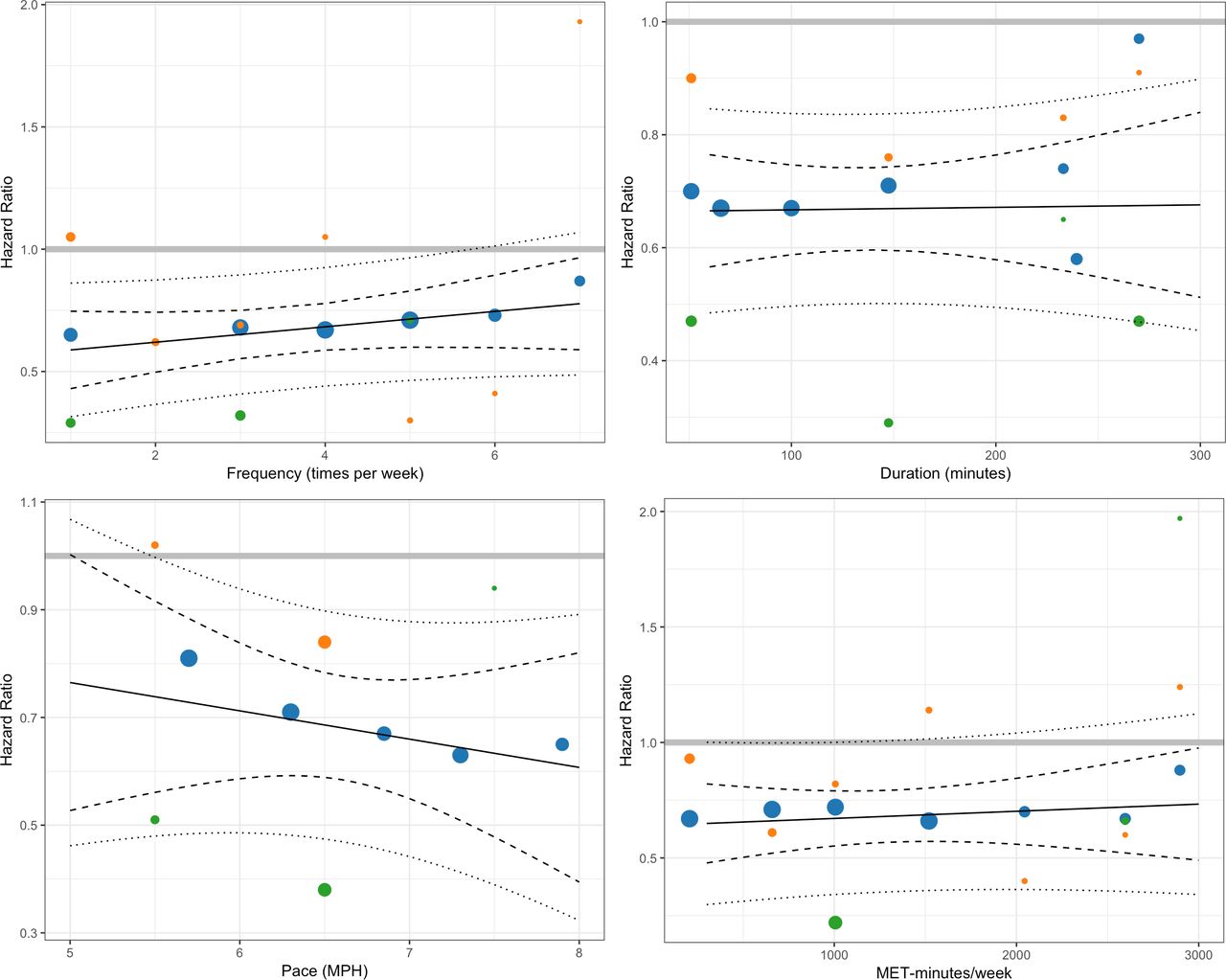
And then the key sentence, the one that settles most of the debate: a meta-regression across all these studies found no significant dose-response trend for weekly frequency, weekly duration, pace, or total volume of running.
In plain terms: pooling hundreds of thousands of people across multiple countries and decades, researchers could not find evidence that running more got you progressively more protection. The benefit came from being a runner at all. Their conclusion was blunt — any amount of running, even once a week, is better than none, but higher doses are not necessarily associated with greater benefit.
For women specifically, the benefit ran even larger: a 34% reduction in all-cause mortality, versus 27% in men.
So Where Did “Too Much Running Kills You” Come From?
This is where careful reading matters most, because the “excessive running is dangerous” narrative rests almost entirely on one study — and that study is far weaker than its media coverage suggested.
The 2015 Copenhagen City Heart Study, also in JACC, followed 1,098 joggers and 3,950 sedentary nonjoggers. The authors divided joggers into light, moderate, and strenuous categories and reported a U-shaped curve: light joggers had the lowest mortality (hazard ratio 0.22, a stunning 78% reduction), moderate joggers did well (HR 0.66), but strenuous joggers showed a hazard ratio of 1.97 — appearing to nearly double the risk of death, statistically indistinguishable from being sedentary.
That single number — the 1.97 for strenuous joggers — launched a thousand headlines about running yourself into an early grave. Here’s what those headlines left out.
The strenuous-jogger group had 40 people in it. Two of them died.
The entire “strenuous jogging is as deadly as sitting on the couch” conclusion rested on two deaths over more than a decade of follow-up. With numbers that small, the statistical uncertainty is enormous. The confidence interval on that 1.97 hazard ratio ran from 0.48 to 8.14 — meaning the true value could plausibly have been a 52% reduction in risk or a near-eightfold increase. A confidence interval that wide, straddling 1.0 so dramatically, means the result is statistically meaningless. It cannot support any conclusion about strenuous running being harmful.
Independent reviewers made exactly this point at the time. As one analysis in the American College of Cardiology’s own journal review noted, the wide confidence intervals surrounding the hazard ratios suggest there was no significant difference between groups of joggers at all. The claimed distinction between light and strenuous joggers was not actually supported by the data. A separate rebuttal letter to JACC was titled, pointedly, “Light and Moderate Joggers Do Not Have Lower Mortality Rates Than Strenuous Joggers.”
There’s a further irony worth noting: the same Copenhagen research group had published an earlier analysis of jogging and longevity finding joggers of all kinds lived substantially longer than nonjoggers, with a hazard ratio of 0.56 for both men and women — a 44% mortality reduction — and made no “running is dangerous” claim at that time.
The Honest Synthesis
Put the whole body of evidence together and the picture is actually quite clear.
Running meaningfully extends life. Across the largest and best-designed studies, runners enjoy roughly a 25–30% reduction in all-cause mortality and up to a 45% reduction in cardiovascular death, worth about three years of life expectancy. This finding is robust, replicated, and consistent across populations.
The dose required is small. The most striking and best-supported finding in this entire literature is how little running it takes. Under an hour a week — even a couple of easy 20-minute jogs — captures most of the available benefit. If you’ve been intimidated out of running because you think you need to train like a marathoner to get the health payoff, the data frees you completely. You don’t.
More running isn’t clearly better for longevity — but it isn’t worse either. Beyond that low threshold, the mortality curve flattens. Additional running brings additional fitness, enjoyment, performance, mental health, and body composition benefits — all real and valuable — but not necessarily additional years of life. The longevity return on your 40th weekly mile is smaller than the return on your first.
The “too much running kills you” claim is not supported. It rests on a single subgroup of 40 people and two deaths, with a confidence interval so wide the result is statistically empty. Larger studies with vastly more high-volume runners have found no mortality penalty at high doses. The theoretical concern about extreme endurance exercise and cardiac remodeling remains an open research question, but as a population-level claim about mortality, “run less or you’ll die sooner” has no solid evidentiary basis.
What This Means If You’re Over 50
For masters runners, this synthesis is liberating in both directions.
If you’re running high mileage because you love it, chasing a marathon, or training for performance — keep going. The evidence does not say you’re harming your longevity. The strongest data available finds no mortality penalty for higher doses, and the scary headline that suggested otherwise doesn’t survive scrutiny.
If you’re running modestly — a few easy miles a few times a week — you are not shortchanging yourself on the longevity benefit. You’re sitting right in the zone where the mortality curve does its most important work. You’ve already bought nearly the entire life-extension payoff that running has to offer.
And if you’re a nonrunner reading this: the single largest jump in benefit is the one from zero to something. Not zero to sixty miles a week. Zero to a couple of easy jogs. That first step off the couch is, by an enormous margin, the most valuable mile you will ever run.
The dose-response research doesn’t ask you to run more. It asks you to run at all — and then to run in whatever amount fits your life, your joints, and your joy. On the question of how long you’ll live, that turns out to be enough.
Key Sources
- Lee DC, Pate RR, Lavie CJ, Sui X, Church TS, Blair SN. Leisure-Time Running Reduces All-Cause and Cardiovascular Mortality Risk. Journal of the American College of Cardiology. 2014;64(5):472-481.
- Pedisic Z, Shrestha N, Kovalchik S, et al. Is running associated with a lower risk of all-cause, cardiovascular and cancer mortality, and is the more the better? A systematic review and meta-analysis. British Journal of Sports Medicine. 2020;54(15):898-905.
- Schnohr P, O’Keefe JH, Marott JL, Lange P, Jensen GB. Dose of Jogging and Long-Term Mortality: The Copenhagen City Heart Study. Journal of the American College of Cardiology. 2015;65(5):411-419.
- Schnohr P, Marott JL, Lange P, Jensen GB. Longevity in Male and Female Joggers: The Copenhagen City Heart Study. American Journal of Epidemiology. 2013;177(7):683-689.