If you’ve been running for decades, you may have noticed something: your stride feels different than it did at 30. Not worse, necessarily — just different. You might be working just as hard, covering the same miles, staying just as consistent. But something has shifted in the mechanics.
A 2023 systematic review published in Sports Biomechanics (Klein & Patterson) is one of the most rigorous attempts to quantify exactly what that shift looks like. Fourteen cross-sectional studies, 862 participants, ages spanning 20 to 80. The findings are specific, important, and in some ways, reassuring.
The ankle is where it starts
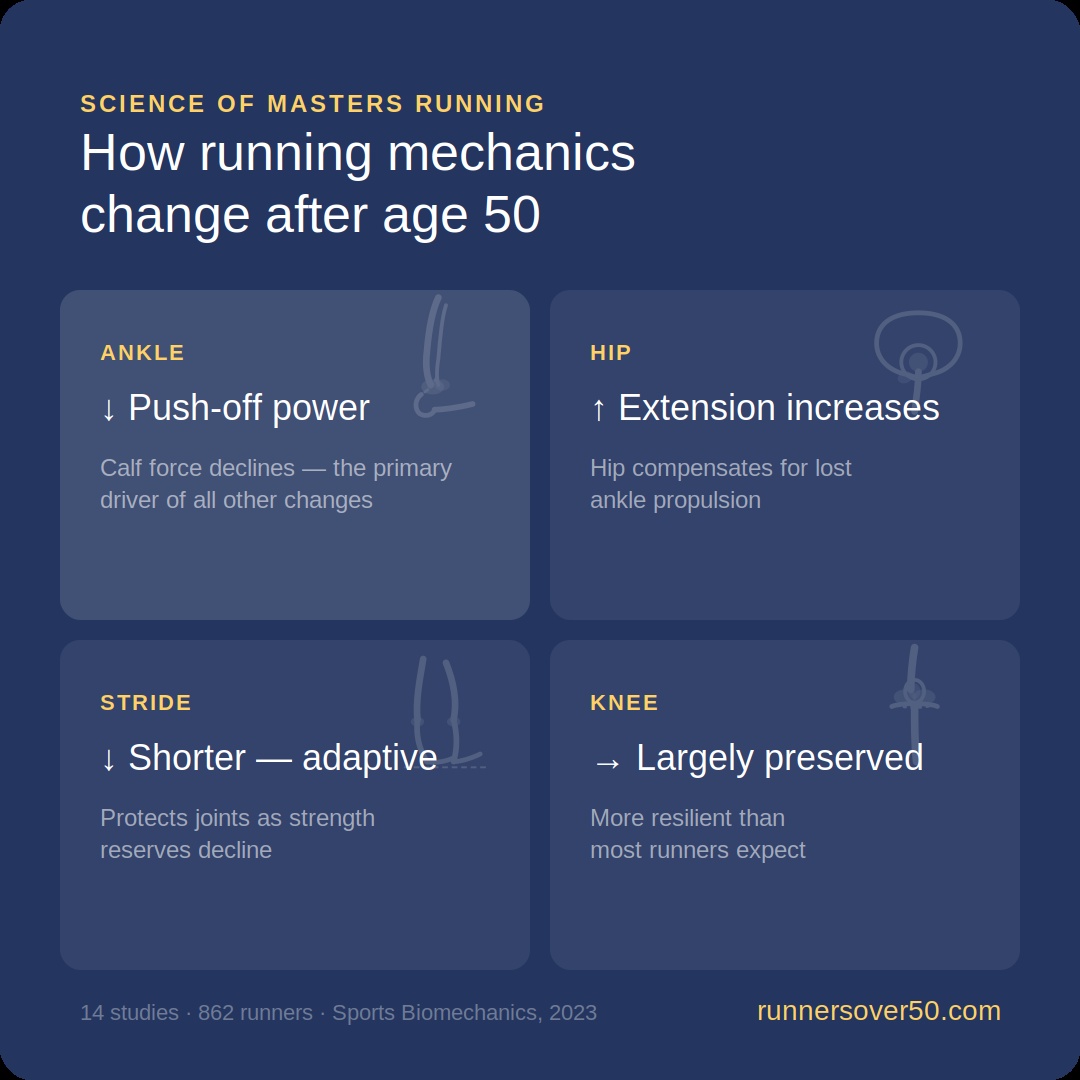
The most consistent finding across the studies: masters runners generate significantly less force at the ankle. Plantar flexion moments — the torque that drives your foot through the ground — decrease with age. Propulsive ground reaction forces decline. Horizontal braking forces decrease.
The authors trace this to the gastrocsoleus complex: the calf musculature that functions as the primary propulsive engine during running gait. With age, that engine loses power. This isn’t injury — it’s the normal, well-documented loss of distal muscle strength that occurs in the aging population.
This one change cascades through the entire kinematic chain.
The hip compensates
Here’s what I find most clinically interesting: while ankle function declines, hip extension actually increases in masters runners. The hip works harder as the ankle works less.
The proposed mechanism is this: as the ankle loses its ability to drive forward propulsion in terminal stance, the hip extends further and for longer to compensate. The prolonged terminal stance phase explains the increased peak hip extension observed across multiple studies. The hip is picking up the slack.
This matters practically. It means the hip flexors — particularly the iliopsoas — are absorbing more load over time, not less. For runners managing hip flexor tendinopathy or proximal hip symptoms, this data provides a plausible biomechanical explanation for why those problems become more common with age.
The knee, surprisingly, is mostly preserved
Across most of the included studies, knee extension moments did not differ significantly between masters and younger runners. This is counterintuitive to many runners who assume that knee pain and degeneration are the dominant age-related story.
The authors suggest this preservation is partially explained by stride length reduction — shorter strides lower the support moment required during stance, which offsets the need for higher knee extensor force. In other words, the shorter stride isn’t just a limitation. It may be a structural adaptation that protects the knee.
Shorter stride length: limitation or adaptation?
Six studies consistently found shorter stride lengths in masters runners compared to younger controls. The common interpretation is that this represents decline. The review offers a more nuanced reading.
Shorter stride length reduces the shock absorption demands on the lower extremity. Given that masters runners are losing strength, power, and the capacity to absorb load, reducing stride length may be the body’s most efficient available strategy. It accomplishes more — in terms of protecting tissue — than simply increasing cadence, which would require higher levels of limb stiffness that masters runners are also known to lack.
Foot strike pattern, notably, showed no significant age-related differences across five studies. Whatever else changes, how the foot contacts the ground does not appear to be a primary age-related variable.
What this means for your training
A few things follow directly from this research:
Calf strength is the highest-yield intervention for masters runners. If ankle propulsion is the primary site of age-related decline — and this review strongly suggests it is — then gastrocsoleus strengthening is not optional maintenance. It is the core of a masters-specific training program. Progressive calf raises, loaded eccentrics, and single-leg strength work deserve the same attention as mileage.
Hip flexor loading increases with age, even as ankle loading decreases. If you’re experiencing proximal hip symptoms in your 50s or 60s, the biomechanics support this being a real, structurally driven phenomenon — not imagined, not just fatigue.
Stride length reduction is not always something to train away. Some runners assume a shorter stride represents a problem to be fixed with drills and mobility work. In the absence of other limiting factors, the body may be self-selecting a stride length that manages load appropriately. Context matters.
The knee is more resilient than the popular narrative suggests. Knee extension moments appear largely preserved in masters runners across studies. The ankle and hip are the more dynamic age-related story.
The open question
The review closes with a sentence worth sitting with: the authors note that whether these biomechanical changes are reversible remains an unanswered question. The studies in this review were all cross-sectional — snapshots, not longitudinal tracking. We know masters runners look different from younger runners biomechanically. We do not yet know how much of that difference can be modified with targeted intervention.
That’s the experiment worth running.
Klein M, Patterson C. Changes in running biomechanics in master runners over age 50: a systematic review. Sports Biomechanics. 2023;24(5):1168–1196.
— Dr. Lyle Dennis | runnersover50.com