A new muscle biopsy study just drew a hard line between the aging you can’t stop and the aging you’re choosing.
Researchers at Amsterdam UMC and Maastricht University put 47 people through the full omics workup — transcriptomics, metabolomics, lipidomics — on skeletal muscle biopsies taken before and after a standardized 1-hour cycling bout at 50% of max wattage. The cohort: 11 young adults, and 36 older adults (65–80) split into three groups by actual habitual activity, not self-report:
- Trained: 3+ structured sessions/week, 1+ hour each, sustained unbroken for over a year (n=16)
- Normally active: no more than 1 structured session/week (n=15)
- Physically impaired: scored ≤9 on the Short Physical Performance Battery (n=5)
Notice the bar for “trained.” No pace requirement. No intensity threshold. No sport specified. Three hours a week, for a year, done consistently. That’s it. Keep that number in mind — it makes what follows more impressive, not less.
Finding 1: Training Erases Half the “Normal” Aging Signature
At baseline, older adults showed reduced expression of the genes running cellular respiration and energy metabolism — the strongest aging signal in the whole dataset. Expected.
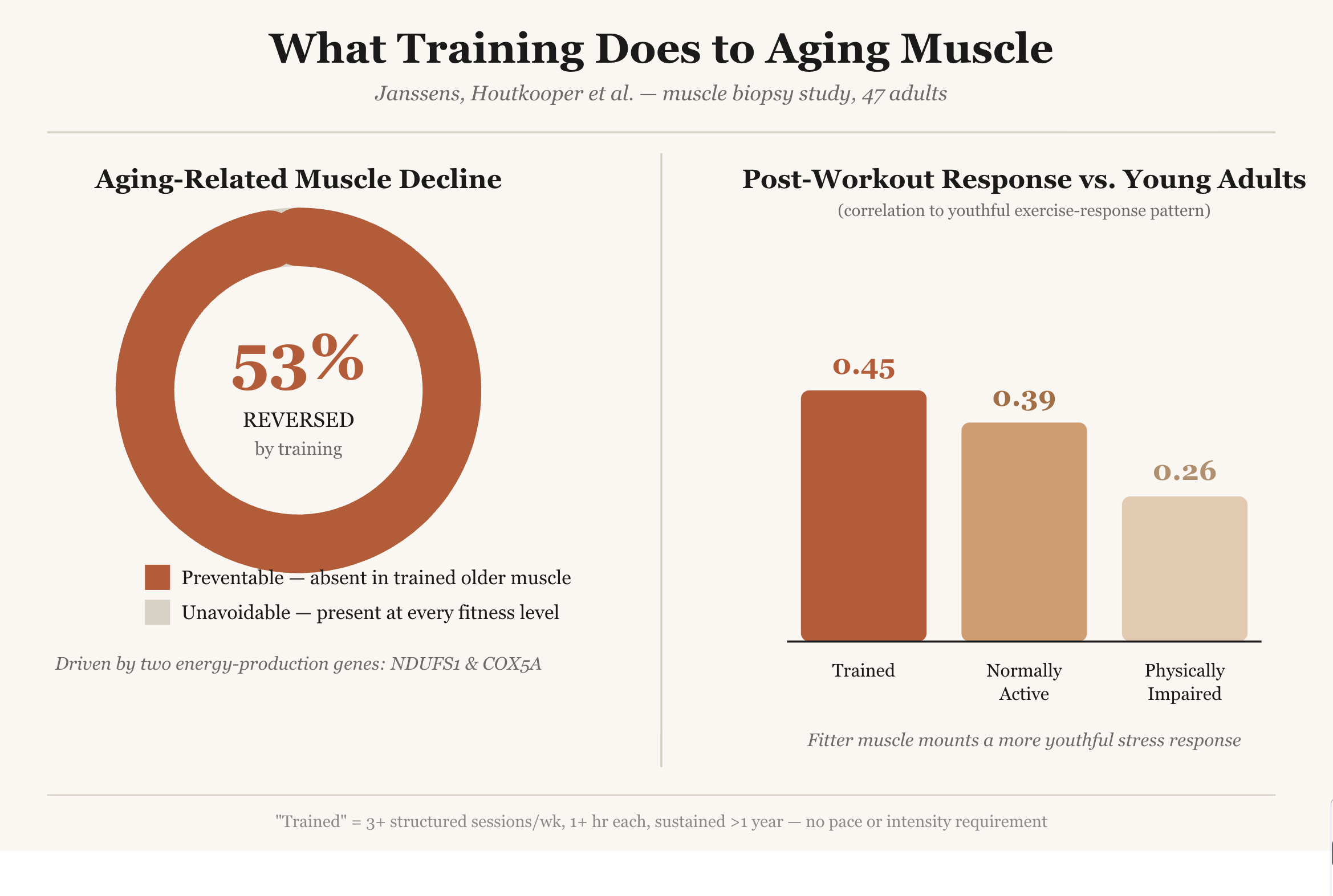
Here’s what wasn’t expected: in the trained group, 45–62% of those age-related differences were simply absent. Their respiration gene expression didn’t just beat their sedentary peers — it statistically matched the young adults’.
Two genes drove much of this: NDUFS1 and COX5A, both core electron transport chain components — literal energy-production machinery. Both declined with age. Neither declined in the trained group.
The researchers split aging changes into two categories:
- Preventable — absent in trained older adults (this includes the dominant respiration/energy signature)
- Unavoidable — present regardless of fitness (scattered genes like PCDH8, UNC13C, DAAM2, CTR9, with no unifying pathway — more noise than program)
The physically impaired group had its own distinct fingerprint: depletion of mitochondrial ribosomal genes (MRPS16, MRPL39, MRPL35, MRPL34, MRPS18C) — the machinery that builds mitochondria’s internal protein factory. A specific molecular signature of decline, sitting right next to a specific molecular signature of protection.
Finding 2: A Big Post-Workout Response Is a Sign of Reserve, Not Fragility
Everyone — every group, every age — activated an immune/stress-response gene program after the bike test (IL-6, IL1B, IL1RN, TNF, SELE, FOS). But the strength and shape of that response tracked with fitness. Correlating each older group’s response pattern to the young adults’:
- Trained: r = 0.451
- Normally active: r = 0.394
- Physically impaired: r = 0.263
The fitter the muscle, the more its exercise response looked like a young person’s. A robust stress response isn’t a red flag in trained muscle — it’s a marker of preserved capacity.
The authors go further, flagging a real concern: longevity drugs built around suppressing inflammation — they specifically name IL-11 inhibitors — could blunt this exact beneficial exercise response, potentially undercutting the functional resilience they’re meant to protect. A pointed challenge to the “just suppress inflammaging” camp, from a team that just mapped the muscle transcriptome in detail.
The Takeaway
- The threshold for benefit is low. Three hours a week, consistently, for a year — not an elite training load — rescued nearly half of an aging transcriptional signature.
- Specific, high-value machinery gets protected. NDUFS1 and COX5A aren’t housekeeping trivia — they’re core to the muscle’s actual energy-production capacity.
- Post-exercise soreness and inflammation are doing real work. In fit older muscle, a strong response tracks with youth, not damage.
- Not everything is reversible. 38–55% of the aging signature held even in trained muscle. Training wins a large share of the argument — not all of it.
Source: Janssens, G.E., Kotte, M., Grevendonk, L., Scantlebery, A., et al. “Delayed molecular aging, preservation of energy metabolism and enhanced exercise response in exercise-trained human muscle.” Preprint (Research Square, CC BY 4.0), now in Nature Aging (2026). doi.org/10.21203/rs.3.rs-6074097/v1